Greed: The True Cause of Obesity
Dr Sean Wheatley, MSc, PhD; Science and Research Lead at X-PERT Health
Sean.Wheatley@xperthealth.org.uk
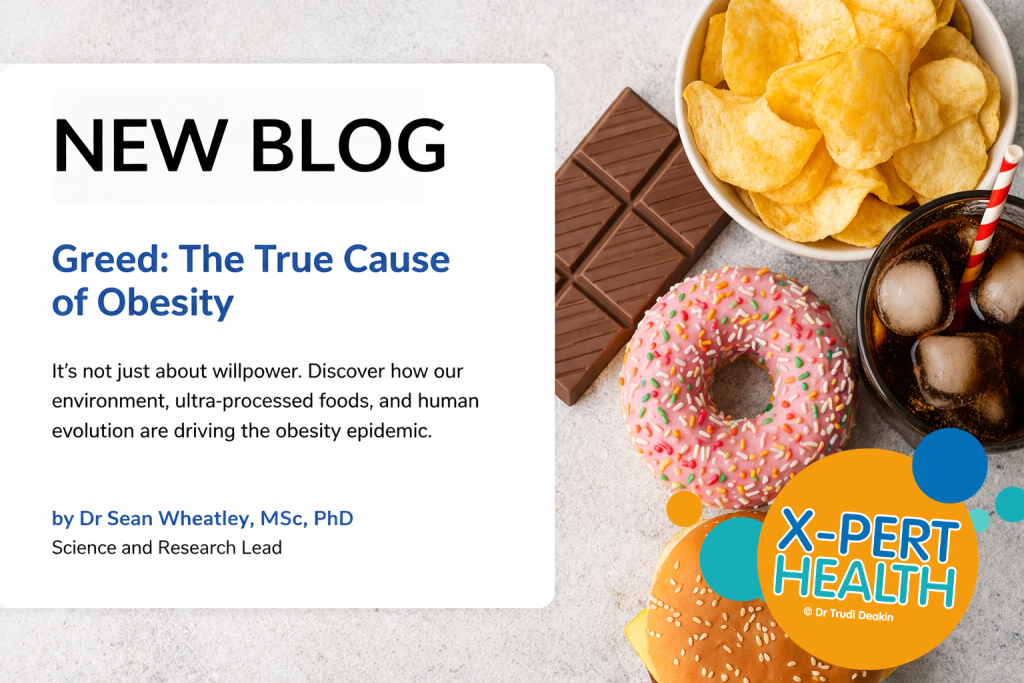
Obesity is a problem. It significantly increases the risk of health problems, and the management of obesity and its consequences places an incredible strain on health services.
Most people think obesity is a problem with an obvious cause – eating too much because of a lack of self-control. In other words, they believe that obesity is caused by greed.
This is a simple explanation, but it is untrue. We can’t conceivably, as a species, have lost our collective self-control within a few generations in a way that would explain the dramatic rise in the number (and percentage) of people with obesity*.
Yet, at the same time, it could be argued that blaming the current astronomical rates of obesity on greed is entirely correct. There are two broad reasons for this:
– Greedy governments and businesses have created a world where it is difficult to avoid gaining weight.
– The way humans have evolved makes it difficult to avoid overconsuming food – a greed developed to help us survive.
Greed may therefore be the cause of obesity after all, just not in the way people think.
Greedy Society
The true cause of the obesity epidemic is (arguably, at least) not greed on an individual level, but greed on a societal one. Economic factors are – unsurprisingly – the main driver. Money brings greed, and that greed has caused nothing but problems for health and wellbeing. Ultimately, both businesses and governments have put wealth above health, and continue to do so.
The Role of Businesses
Businesses want to make money. When they make money, they want to make more of it. In the food industry, this has contributed to increasing obesity rates in multiple ways, including through:
– The development of ultra-processed foods (UPFs), many of which have been specifically designed to be hard to stop eating and to make people want more of them. The impact of UPFs is discussed further later on.
– The way their products are marketed, which has been carefully honed to influence people’s behaviour. This includes through large marketing campaigns, the way certain products are packaged and branded, and clever techniques used within shops. Together, these make certain products hard to avoid and hard to resist.
Both the development of UPFs and the way in which such products are marketed has been for the sole purpose of increasing profits; hence, greed is the driver.
The Role of Governments
The main way in which governments are culpable is perhaps through a lack of regulation to prevent some of the practices used by businesses. This is often not down to a simple lack of action, but rather is caused by lobbying from these businesses and/or conflicted interests within the governments themselves. A recent example demonstrating this is the repeated delays to the introduction of a ban on advertising junk food before 9pm in the UK, something which was lobbied against by the food and drink industry.
In addition, government interests are often intertwined with those of businesses due to the impact the success of those businesses (or the lack thereof) can have on the wider economy. This often leads to the interests of those businesses being placed above health-related considerations**, which is a little short-sighted given the longer-term costs of worsening health across the population (e.g., because of increased rates of health conditions leading to increased management and treatment costs, increases in absences from work due to ill health, increases in the number of people claiming certain benefits, etc.).
The Food Environment
The combined influence of the actions of businesses and governments has created an environment where it is easier to make unhealthy choices than healthy ones. Reasons for this include:
– Cost: e.g., healthier foods cost over twice as much per calorie as less healthy foods.
– Availability: Ultra-processed foods are often much more readily available than minimally processed foods. There are, for example, a lot more takeaways around than there are butchers or greengrocers.
– Marketing: Ultra-processed foods are advertised and promoted much more widely than minimally processed foods are
Greedy People
As noted previously, people are inherently greedy, and this may help to explain rising obesity rates. This is not down to gluttony in the way some people falsely believe though, but rather is related to a disconnect between the world humans evolved in and the world we live in today.
Evolved Behaviours
On an individual level people have not become greedier, they have always been greedy. Our ancestors would not always have had large volumes of food available. This means they would go through periods of feasting, followed by spells of enforced fasting. Greed was necessary to maximise opportunities to feed when they presented themselves, to mitigate for potential periods where food was scarce (e.g., if a forager came across a bush with berries, their urge would be to consume as many as possible as there would be no guarantee there would still be berries left tomorrow).
As evolution takes place over millions of years, humans are, biologically, still much the same as they were when they were cave-dwelling hunter-gatherers. Culturally though, the human species has “evolved” very quickly. So, biologically, we are still driven to take the opportunity to consume food when it is available; the problem, in the developed world, is that it almost constantly is.
The Impact of Ultra-processed Foods
What has turned this evolved greed into a real issue is the development of UPFs. As noted above, these have been developed to make us want to eat more of them, and to make them hard to stop eating once we start. They do this in multiple ways, including by:
– Combining ingredients in ways that do not exist in nature,
– By using ingredients (often artificial ones) in ways that enhance flavours,
– By processing the ingredients in ways that affects the texture of the product and how quick and easy it is to eat and digest.
The net result is the creation of products that affect the brain in ways that minimally processed foods usually don’t. They can bypass or override the control mechanisms the body has developed to moderate eating behaviour, through an impact on hunger and satiety for example. They can cause cravings and desires to seek out these foods. They can make it almost impossible to stop eating them once we start.
Worst of all, to reiterate a previous point, they have been designed by greedy business to do this by hijacking the processes in the body that make people inherently greedy to start with.
So, What’s the Bottom Line?
The greed of businesses has resulted in people being bombarded with food-related marketing that is difficult to avoid and resist, and ever-increasing amounts of ultra-processed foods that are difficult to control the intake of. This has taken advantage of an innate greed that has evolved in humans to guard against starvation, and governments have done nothing to stop it. The result is increasing waistlines and worsening health throughout much of the world.
Greed is therefore perhaps the cause of the obesity epidemic after all, albeit not in the way many people assume it is.
Blaming the obesity epidemic on a lack of individual willpower is not just wrong though, but convenient. It lets businesses and governments off the hook, and it distracts from the need for structural and societal changes to be made (such as the regulation of UPFs and/or to food marketing). This should not, and cannot, be allowed to happen. There are signs of a sea change, such as through the new US Dietary Guidelines’ focus on “real” foods (and concurrent demonisation of UPFs), but there is more to be done.
* The same reason rules out genetics as the cause. Although it may explain why some people are more likely to become obese than others, it cannot explain why rates of obesity have increased so significantly in such a short period of time, as our genetics cannot feasibly have changed dramatically within this timespan.
** It is worth acknowledging that these factors are not entirely independent, with economic factors (including in relation to employment status, working conditions, and income) having an impact on health and wellbeing too. The broad point holds true though.
