The New Dietary Guidelines for Americans – Change for the Better?
Dr Sean Wheatley, MSc, PhD. Science and Research Lead.
As much as they do not apply to us directly here in the UK, the publication of new dietary guidelines in the United States is always of interest. That is particularly true this time round, given the significant shift in the nature of these recommendations compared to past versions.
It is also worth bearing in mind that the previous US guidelines were fairly consistent with the UK guidelines, so any major changes result in there being significant differences between the US and UK too.
With this in mind, this month’s blog takes a look over the new Dietary Guidelines for Americans, and considers whether we would be better off if the UK took a similar approach.
Introduction to the New Guidelines
The new Dietary Guidelines for Americans can be seen at https://realfood.gov/, but the most important points are outlined below.
The first point, and perhaps the most significant, is that their overriding focus is now on the avoidance of highly processed foods and the promotion of “real” ones. This in itself is a fairly major shift from previous recommendations.
“Real Foods” have been defined as “…foods that are whole or minimally processed and recognizable as food”, with such food being “…prepared with few ingredients and without added sugars, industrial oils, artificial flavors, or preservatives.”
The New Pyramid
Beyond the change of focus to real versus processed foods, there has been a notable shift in the types of foods that are promoted and the amounts it is suggested they be consumed in. These are summarised in “The New Pyramid” (see below), which, importantly, is essentially a flipped version of the old one.
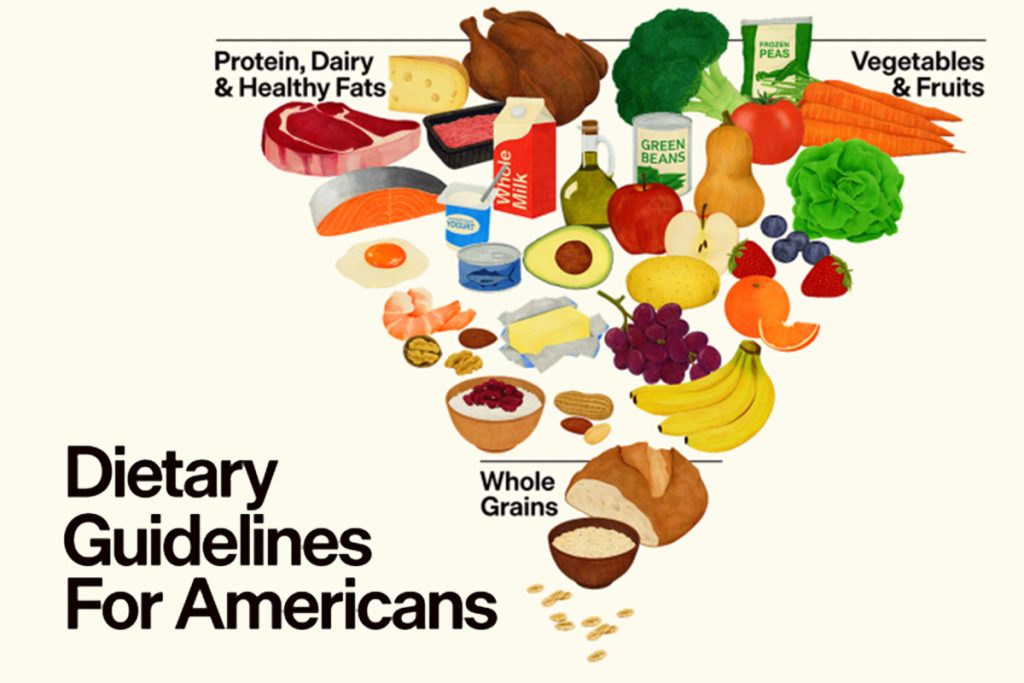
Key differences are outlined below.
Previously:
– Starchy carbohydrates formed a broad base to the pyramid, with the recommendation being to have 6 to 11 servings per day from the “bread, cereal, rice and pasta” group. It was encouraged that meals be built around these foods.
– Proteins and healthy fats constituted a relatively small portion of the pyramid, with the recommendations being to have 2 to 3 servings from the “milk, yogurt and cheese” group, and 2 to 3 servings from the “meat, poultry, dry beans, eggs and nuts” group. Lean proteins were favoured.
– Vegetables and fruits were heavily promoted. Recommendations were to have 3 to 5 servings of vegetables per day, and 2 to 4 servings of fruit.
Now:
– It is more clearly stipulated that where carbohydrates are consumed they should be whole grains (indeed, the relevant group is now labelled as “whole grains” in the pyramid itself), and that refined carbohydrates are not encouraged. Even taking this into account, the new recommendations are for people to have just 2 to 4 servings per day from this group, a notable reduction from the previous guidelines.
– It is encouraged that meals should “prioritize high-quality, nutrient-dense protein from both animal and plant sources, paired with healthy fats from whole foods such as eggs, seafood, meats, full-fat dairy, nuts, seeds, olives, and avocados.” This is a major change.
No recommendations are included for number of servings per day from these groups; individual needs will define what is “right”, with this open-ended guidance allowing greater flexibility for people to apply the guidelines in a way that works for them. If individuals do build their meals in this way, it should (in theory at least) be difficult for them to overeat due to the fact these foods are generally very filling.
Although specific serving recommendations are not included, a portion target of 0.54 to 0.73 grams of protein per pound of body weight is included (which equates to 1.2 to 1.6 grams per kilogram; N.B. these targets would be based on target/ideal body weight, rather than current body weight).
It is also worth noting that the previous recommendation to try and restrict the consumption of saturated fats to less than 10% of total energy intake has been retained, something I will explore a little further later.
– Vegetables and fruits are still prominent in the guidelines, in what is probably the biggest consistency with the previous iteration. The stated recommendations for each are at the lower end of the previous range though, at 3 and 2 servings per day, respectively.
Any other differences?
Importantly, and as briefly alluded to above, the new guidelines are intended to be a “flexible framework” rather than a prescriptive dietary approach. This is another key difference to the previous guidelines, which for all intents and purposes promoted a low-fat dietary approach.
The new guidelines therefore provide scope for individuals to apply them in a way that suits them, supporting “cultural traditions, personal preferences, and different lifestyles.” This could be achieved through adopting any of a range of different dietary approaches, including but not limited to Mediterranean-style, low carb, and/or vegetarian or vegan eating patterns.
The new guidelines also explicitly acknowledge that “Individuals with certain chronic diseases may experience improved health outcomes when following a lower carbohydrate diet.” Although disease-specific guidelines (e.g., for type 2 diabetes) have acknowledged the potential benefits of carbohydrate restriction for a while it is refreshing to see this acknowledged in prominent national guidelines targeted at a broader audience.
Overall impressions
Given that the core messages in the new US dietary guidelines are very much compatible with the key messages of our programmes and resources at X-PERT Health, I (for the most part) like them!
At X-PERT Health, we encourage people to:
– Minimise their intake of ultra-processed foods.
– Choose minimally processed options as much as possible.
– Build their meals around a good quality source of protein.
– Not be afraid of consuming minimally processed fat-containing foods and drinks.
– Pick a dietary approach that fits their needs and preferences, acknowledging that one-size-does-not-fit-all.
The new US dietary guidelines tick all these boxes in a way that the previous guidelines did not, and that the current UK dietary guidelines (the Eatwell Guide) still don’t. As a result, it is certainly my opinion that the changes that have been made are a significant improvement, and that the UK would do well to follow suit.
It is also worth mentioning that the key messages here are relatively simple, and thus (hopefully) easy for people to understand and apply. That is something that is often not true of public health messaging. There is of course still significant work to be done to change the food environment in a way that supports people in improving their diet (in relation to affordability and how products are marketed, for example), but it is still a step in the right direction.
Any negatives?
I did think that the number of daily servings suggested for vegetables was unnecessarily low. My concern is that it might lead people to believe that having more than three servings of vegetables per day would be a bad thing. I simply don’t think this is true.
The retention of the previous recommendation (3 to 5 servings per day) may have been better. Alternatively, this could perhaps have been framed to encourage at least three servings of vegetables per day (though possibly with caveats around which types of vegetables should make up the bulk of this).
I also do not like the guidance on saturated fat. This is explored below.
Further thoughts, Part 1 – The Focus on Processed Foods
It is worth acknowledging that many people do not like recommendations based on avoiding processed foods. These people will therefore not like these new guidelines. Although I understand some of the concerns, I do not agree with them.
My overall opinion on this topic is that the pros of encouraging people to avoid ultra-processed foods outweigh the cons, making this useful public health advice. This subject was explored further in one of our previous blog posts, should you be interested in reading more.
Further thoughts, Part 2 – The Position on Saturated Fat
The last thing I want to discuss is the decision to retain guidance to limit saturated fat intake to less than 10% of total energy. I think this is misguided, and inconsistent with the rest of the update.
I think it is misguided because it treats all saturated fat as the same, when it is clear that different foods that contain saturated fat have different effects on health.
I think it is inconsistent with the rest of the update because a range of foods are promoted specifically because they contain “healthy fats”, including multiple examples where a significant proportion of the fat they contain is from saturated fat. It begs the question, if someone exceeds the 10% suggestion but with all of this saturated fat coming from dairy products, meat, butter, nuts, oily fish and olive oil (all of which are included in The New Pyramid), is this an unhealthy diet?
Ultimately, the retention of this recommendation seems contradictory. I am very much of the opinion that the guidelines would have been clearer (and no-less conducive to promoting good health) had this suggestion been omitted.
So, what’s the bottom line?
The new Dietary Guidelines for Americans represent a seismic shift from previous versions, with the food pyramid being turned on its head. The new guidelines focus on minimising the intake of ultra-processed foods and consuming plenty of nutrient dense options instead, with an increased attention on (and promotion of) protein-based foods and foods that contain healthy fats.
The updated guidelines are also much more flexible, so can be used to help people adopt a dietary approach that fits their own needs and preferences better than the previous guidelines did (and the current UK guidelines do).
Overall, these guidelines are largely consistent with the advice X-PERT Health provide in our programmes and resources, and as such I am supportive of them. Although there are still a couple of things I would change, I firmly believe that the UK could do much worse than updating our own dietary guidelines in the same way.
