Blog: The quad-cycle hypothesis – a(nother) “new” theory of type 2 diabetes
Dr Sean Wheatley, MSc, PhD; Science and Research Lead at X-PERT Health.
Sean.Wheatley@xperthealth.org.uk
My last two blogs introduced the tri-cycle hypothesis of type 2 diabetes, then discussed the practical implications of this. The whole premise of these blogs was that the “twin cycle hypothesis” of type 2 diabetes might have a missing piece. Perhaps ironically, this blog is going to outline why the tri-cycle hypothesis might be omitting an important part too.
So, this month’s blog is going to introduce a whole new theory of type 2 diabetes – the quad-cycle hypothesis!
The Twin Cycle Hypothesis
Professor Roy Taylor’s twin cycle hypothesis of type 2 diabetes sets out how cycles within the liver and pancreas can ultimately lead to type 2 diabetes. The gist is that a build-up of fat in each of these organs leads to cycles of deteriorating function, increasing insulin resistance, and higher blood glucose levels as a result.
The Tri-Cycle Hypothesis
My musings around a “tri-cycle hypothesis” suggested that the role of the muscles is understated in the twin cycle hypothesis. As a major potential destination for glucose, skeletal muscle plays a significant role in relation to metabolic health. There is even evidence that issues with how the skeletal muscle deals with excess glucose in the body develop before the issues that are seen in the liver and pancreas.
The gist of the tri-cycle hypothesis is therefore, simply, that issues in the liver, pancreas and muscles all contribute to the development of type 2 diabetes. See our previous blogs (using the links at the start of this post) for more on this.
The Role of Adipose Tissue – General
Fat storage is clearly important in this picture, with the location of stored fat having a significant bearing on whether things work like they should do. In the body, fat is ideally stored in adipose tissue. When fat is stored in adipose tissue subcutaneously (i.e. under the skin) and peripherally (e.g. on the arms, legs and buttocks) it does not tend to have a major negative impact on metabolic health.
But when the body’s capacity to store fat in these locations is exceeded, the risk of health problems is increased. Instead of being stored safely in dedicated adipose depots, excess fat is redirected elsewhere, where it can have a range of negative effects. This is explored further below.
Different people can store a different amount of fat in the body before issues start to occur. This is where the “personal fat threshold” concept comes from. It is also why some people start to see health problems at a lower body weight/size than others.
The Role of Adipose Tissue – Type 2 Diabetes Development
Simplifying things again, the general progression is:
– The storage capacity of the adipose tissue is exceeded.
– This leads to insulin resistance of the adipose tissue, with its ability to perform its functions (including the safe storage of fat) reduced as a result.
– Levels of circulating fat increase (as less fat is taken up by the adipose tissue).
– There is a subsequent increase in the storage of fat in places where it should not be (e.g. the muscle, liver, and pancreas).
Evidence even suggests that, in some cases, insulin resistance of the fat cells may be a bigger factor in poor metabolic health than insulin resistance of the muscle.
The increase in insulin resistance can also lead to increased insulin levels, and an increased drive towards fat storage in the body. But attempts to increase the storage of fat in adipose tissue when it is already insulin resistant are doomed to fail. Further insulin resistance is just one of the likely outcomes. Ultimately, this reinforces the negative cycle within the fat cells, exacerbating the issue further.
The Quad-Cycle Hypothesis
So, with the introduction of another potential cycle, the theory expands from three cycles to four (see below).
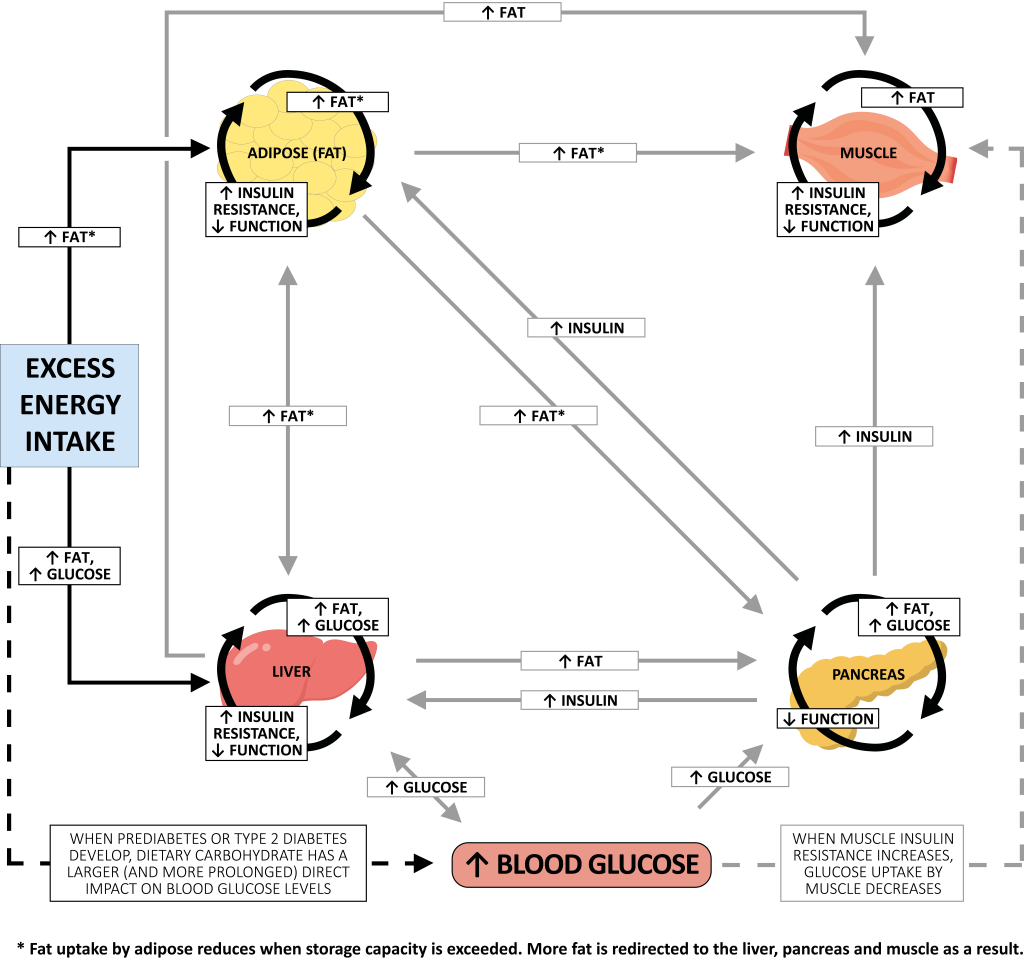
The fourth cycle, in the adipose tissue, is broadly similar to the others. In each case:
– An excess of energy (in the form of fat and/or glucose) exceeds the cell’s ability to function properly.
– This leads to an increase in circulating energy, as fat and/or glucose is either expelled or cannot be taken in.
– The increase in circulating energy (from fat and/or glucose) impacts the other cycles.
Without appropriate action, there will be vicious cycles within each of the adipose, muscle, liver and pancreas, leading to ever worsening function. This will lead to ever higher levels of circulating energy, and so vicious cycles between each of the adipose, muscle, liver and pancreas.
Which of these cycles occurs first is likely different for different people. The same treatments outlined in our previous blog still usually apply though:
– Reduce body fat.
– Ensure carbohydrate is not consumed above personal tolerance levels.
– Increase muscle mass.
Where Does It End?
This series of blogs has suggested, with tongue somewhat in cheek, that the widely referenced twin cycle hypothesis of type 2 diabetes has some bits missing. Even the quad-cycle hypothesis is not the full story, though.
Other elements that can play a significant role in the development of type 2 diabetes (in some people at least) include the gut and the brain. These are subjects that we may well discuss in future blogs, though perhaps without adding any additional cycles to our hypothesis!
The four cycles here are perhaps a sensible place to stop for the central theory anyway. The largest depots for the storage of fat and glucose in the body are now all included, alongside the pancreas, which would be a glaring omission from any theory of type 2 diabetes!
So, What’s the Bottom Line?
The tri-cycle hypothesis suggested that the twin cycle hypothesis might be understating the role of skeletal muscle insulin resistance in the development of type 2 diabetes. The quad-cycle hypothesis goes one step further, suggesting that the role of dysfunction within adipose tissue should be included too.
With these additions, all the body’s major destinations for the storage of glucose and fat are covered. An excess of glucose and/or fat within the body can cause issues within each of these possible destinations, and issues within any of them can have a knock-on effect on the others. Without action, a series of vicious cycles can occur, with the development of type 2 diabetes the likely outcome.
Reassuringly though, the same practical steps are likely to help whichever of these cycles are occurring. Reducing body fat, reducing carbohydrate intake to within personal tolerance levels, and increasing muscle mass are all interventions which can help to interrupt these vicious cycles. They can all help people regain control of their metabolic health as a result.
